XHALE CHRONICLES
Angry Farmers — The Fifth Son & Abel
Letters from Xhale · Words that breathe. Stories that linger.
There once was an old farmer—quiet, sharp-tempered, and burdened by a rage he never spoke aloud. He was the youngest of six brothers, long believed to be the most cursed among them. For generations, it was said that one son in each bloodline would inherit the curse, a burden passed not by choice, but by blood.
The farmer had four sons, whom he presented before God as his legacy. To each, he gave an equal share of land and wealth, believing he had satisfied heaven and outwitted fate. But fate does not bargain.
But soon, the brothers began to quarrel. Whispers turned to accusations. Accusations became threats. The farmer could not understand the sudden rot growing among them.
Then the land changed.
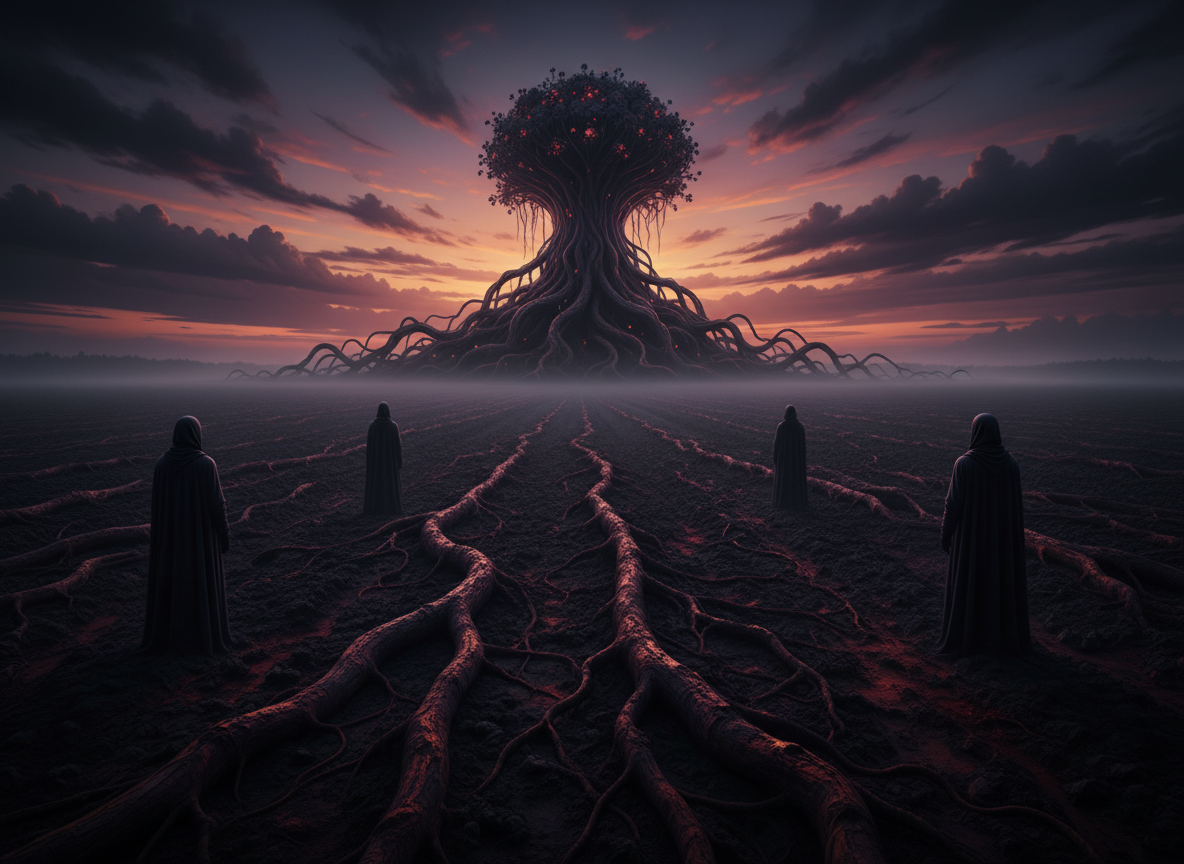
The crops twisted unnaturally, rising from the soil as if they had faces — hands clawing upward, mouths frozen in silent screams. The earth darkened to the color of raw clay, wet and heavy, as though it bled.
In fear, the farmer sacrificed the fifth son. He buried the boy alive in the land, believing the curse demanded blood. In doing so, the farmer became something worse than cursed—he became a murderer.
The land wept. Crops died. The soil turned to dust. The farmer retreated into solitude, while his remaining sons lived under the shadow of what had been done.
Years later, a single green shoot broke through the dead ground.
The farmer called it mercy.
But beneath the soil, the fifth son awoke.
He was not alone.
From the depths came a voice older than the fields, older than the curse itself — a voice that once cried out from the ground.
Abel.
The first murdered son, struck down by his brother, bound forever to the soil that drank his blood.
Abel spoke not with anger, but with truth.
“The ground remembers,” he said. “It knows the innocent from the guilty. It knows who was taken… and who took.”
Abel taught the fifth son how the land listens, how roots carry memory, how blood seeps into earth and waits. He showed him that the soil does not forget sin — it multiplies it.
Together, they stirred the ground.
The green plant above grew strong, fed not by forgiveness, but by remembrance. Its roots wrapped around the fifth son’s bones, and through them, Abel’s ancient grief flowed upward.
The farmer rejoiced, believing the land healed.
But the harvest was not for him.
As fruit ripened, the remaining sons dreamed of choking vines and whispering fields. The land no longer screamed — it judged.
Abel did not seek revenge. He sought witness.
The fifth son did.
And through Abel’s guidance, the fifth son learned how to make the land answer for spilled blood.
When the harvest came, the fields stood tall and silent.
Waiting.
For the guilty to walk among them.
Because forgiveness had never been asked for.
The four brothers did not gather.
That was the first truth the land had to reckon with.
They had spent too many years on separate plots, building separate silences, to suddenly stand together in a field and confess. That is not how real men work. That is not how inherited guilt moves through a family.
It moves slowly.
It moves through the crops that refuse to yield the way they used to.
It moves through the arguments that start about land and end about something nobody will name.
It moves through the dreams.
Each brother dreamed differently.
The eldest dreamed of a boy running through the field — not chasing, not fleeing, just running the way children do when the world still belongs to them. He woke angry and didn’t know why.
The second dreamed of the same field flooded, waist-deep in dark water, and something beneath the surface pressing upward against the soles of his feet. Not attacking. Asking.
The third didn’t dream at all. He hadn’t dreamed in years. He told himself that meant he was fine.
The youngest dreamed of their father. Sitting at the kitchen table. Hands folded. Eyes closed. Waiting for someone to ask him something he would never answer on his own.
The land did not demand a confession.
It demanded a reckoning — and a reckoning doesn’t always look like justice. Sometimes it looks like a man standing at the edge of his field at dusk, holding a tool he doesn’t use, staring at a plant he didn’t grow, knowing something is there that he can’t explain and can’t ignore.
Sometimes it looks like one brother calling another after years of distance, not knowing why, just knowing the silence had gotten too heavy to carry alone.
Sometimes it looks like the youngest—the most restless, the one who remembers the most—writing it all down.
Not to accuse.
To witness.
Because the land taught him what Abel knew from the beginning:
The soil does not need the guilty to confess. It needs someone to remember. It needs someone to say the name of what was buried — and refuse to let it stay forgotten.
The fifth son did not want their suffering.
He wanted his name back in the world.
And somewhere, in the space between one brother’s silence and another’s restless sleep, the land began—slowly, quietly—to breathe again.
— A note from Xhale
"I know four brothers. I know their land, their arguments, their distance. I wrote this story not to expose them but to understand them — and to understand the thing none of us talk about that lives underneath everything we’ve built. The fifth son is real in every family that has buried something and called it done. The land remembers. That’s all this is."
A Xhale Chronicles Story | By Kendrick Howard · Letters From Xhale
 Letters from Xhale the magazine Words that breathe. Stories that Linger,