“Nest of Love — A Quest of Love”
Letters from Xhale — Words that breathe. Stories that linger.
Genre: Animated family comedy / romance / musical — movie plot from the independent, original collection Letters from Xhale.
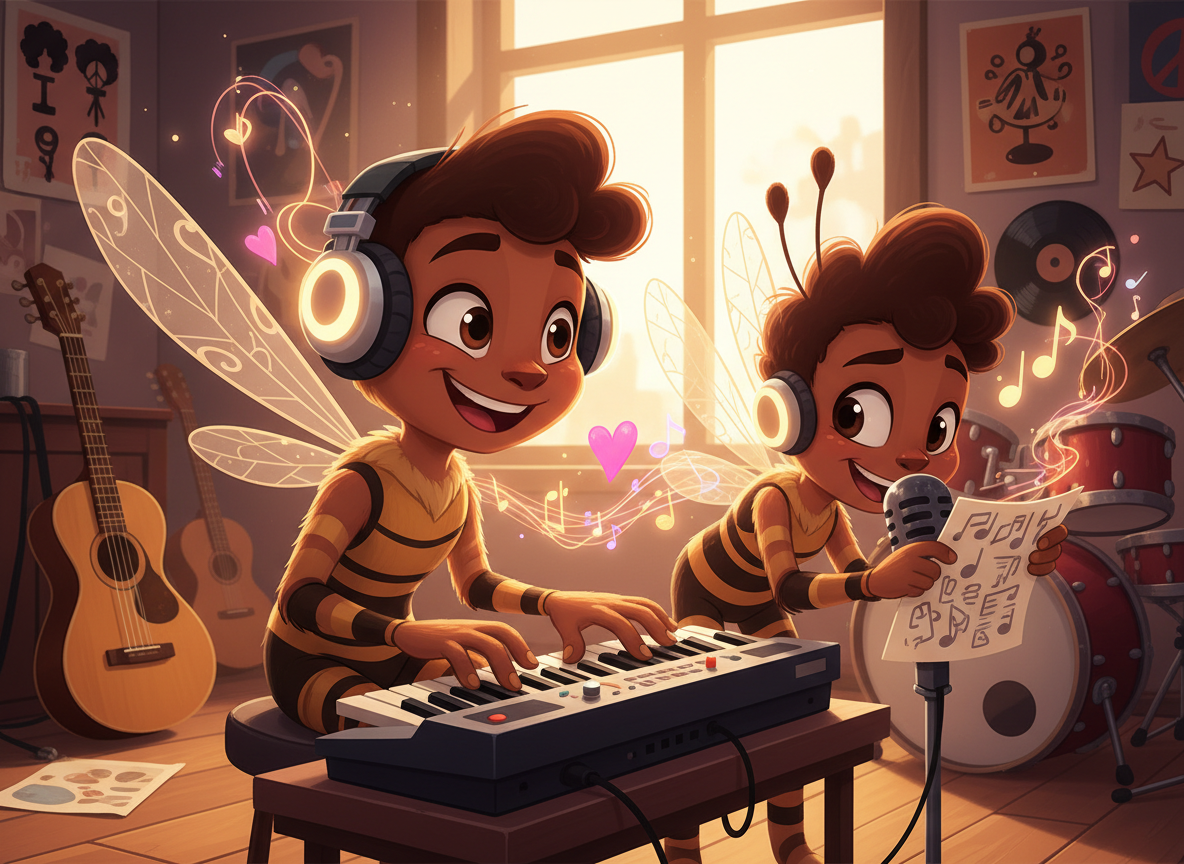
In a glowing, high-rise wasp nest thrumming with African American musical traditions, a shy kid named Kay discovers that love is louder than fear — and that even when the right words won’t come, the right song just might. Nest of Love — A Quest of Love is written as a playful, heartfelt movie plot that sits comfortably in the Letters from Xhale universe: a careful, character-driven story that lets music carry what ordinary language can’t.
Premise: When You Can’t Speak, You Sing
Kay is a young wasp at a buzzing hive school, small in size but big in feeling. Every day, he watches a girl in his class who always wears her headphones: cool, self-possessed, tuned into her own private universe. She moves through the corridors in a calm, confident groove, the kind of kid who never seems to trip over her own feet or her own feelings. Kay falls for her, hopelessly and wordlessly. The problem: he has no idea how to cross the three-foot gulf between their desks and say hello.
At home, things are no easier. Kay’s family is loving, loud, and utterly unequipped to give advice about romance. What they do have, in infinite supply, is music. The nest vibrates with R&B, soul, gospel, funk, blues, doo-wop, jazz, and old-school slow jams. In this world, feelings don’t stay bottled up for long; they slip into melody and climb into harmony. If you stay in this nest long enough, life itself starts to sound like a score.
The Family: A Choir of Imperfect Experts
Kay’s parents are romantics who can’t quite explain how love works, only that it does. His mom carries herself like a soul ballad: warm, steady, velvet-voiced. His dad is all deep, slow-jam tenderness, with a voice that can turn the smallest memory into a late-night radio classic. His sister is mischief and melody in a single, agile line of modern R&B. And then there is Uncle Laa, the family’s resident bluesman: a garage mechanic whose love life is as messy as his workbench, forever singing through the chaos.
The house is an ongoing rehearsal: pots clink in time, doors swing on the backbeat, and arguments have an odd habit of resolving into key changes. No one here has a neat definition of love, but everyone knows how it sounds.
Act One: When Words Won’t Come
The story opens in the rhythm of an ordinary school day. In the classroom, sunlight cuts through the hive’s waxy windows, casting honey-colored beams over buzzing students. That’s when Kay first truly notices the girl with the headphones: her quiet concentration, the way she nods almost imperceptibly to the beat inside her head. Every time Kay tries to edge closer — to hand her a pencil, to say something normal and harmless — his courage evaporates. A dropped notebook here, a mumbled non-sentence there: comedy stitched with genuine ache.
That evening at dinner, the question bursts out of him like a wrong note:
“How do you talk to a girl you like?”
The table falls still. Mom and Dad exchange a look. Kay’s sister raises an eyebrow, sensing opportunity.
Dad clears his throat. “Son… I don’t know.”
Mom sighs, half amused, half sympathetic. “Me neither.”
His sister laughs. “You are all terrible at this.”
But where language stumbles, melody begins. Dad starts humming under his breath, a simple, searching line. Mom picks up the tune, smoothing it into something warm. The sister layers in playful harmonies. Chairs push back, the table becomes a stage, and the first big number arrives: “WHEN WORDS WON’T COME.”
The song is a soul/R&B embrace, a teaching moment that never quite turns into a lecture. They sing about letting your heart find its own tempo, about listening before you leap, about the courage of small beginnings. Kay learns nothing concrete about exactly what to say, but he feels less alone in the not-knowing. In this nest, even confusion is something you don’t have to face in silence.
Act Two: Lessons in Love (and Other Disasters)
Act Two leans into comedy without abandoning the story’s careful emotional spine. Kay’s best friend, all nervous bravado and upbeat funk/hip-hop energy, appoints himself “love coach.” What follows is a series of wildly misguided training montages: practicing casual greetings in the mirror, choreographing the perfect walk, rehearsing how to lean against a locker without falling over. Each attempt at “cool” misfires beautifully.
While Kay stumbles through these mini-disasters, Uncle Laa is waging his own battle in the garage repair shop. The place is a cathedral of clatter: engines suspended like heavy, mechanical hearts; tools scattered like notes on a sheet. Laa sings his way through each task — crooning old-school soul while fixing engines (“Ooooooh, baby…”), sliding into gritty blues while changing tires (“Girl, you know I love you…”), and even testifying in gospel-inflected frustration when he can’t find a wrench (“Where is my wrench?!”).
His wife storms in, fury cutting through the melody. They argue, at first in sharp prose — years of misunderstandings and missed cues rising to the surface. Laa, unable to separate feeling from song, slips back into melody mid-sentence. She snaps at him to stop singing, but emotion catches her too. Slowly, reluctantly, she answers him in kind. Their argument bends, then blossoms, into a soulful duet: “LOVE AIN’T EASY.”
The number is a rough-edged confession that real love is more than butterflies and slow jams: it’s work, apology, and the choice to come back and listen again. On the stairs, Kay watches, eyes wide. This is his first real lesson. Love isn’t just the thrill of seeing someone from across a classroom; it’s the long, imperfect effort of staying.
Back at school, the girl’s three best friends have noticed Kay’s clumsy orbit. In a scene that channels classic girl-group harmony and knowing side-eye, they nudge her with the teasing, infectious song “I KNOW HE LIKES YOU.” They list every tiny tell: the way he drops his books when she walks by, how he turns into a statue when she laughs, how he always sits just one desk too far away. She protests, unconvinced, but the seed is planted.
Back in the nest, Kay’s sister decides subtlety is overrated. In a burst of playful modern R&B, she sings about his crush at full volume, weaving his embarrassment into a melody the whole household can’t help but echo. Kay chases her through corridors and up staircases; the chaos fractures, then resolves, into another family-wide musical swirl. They are, as ever, terrible at advice and brilliant at accompaniment.
The Turning Point: You Gotta Be You
Just when it feels as though the entire nest is singing about his love life, Kay finally gets a quiet chance. In a rare, still hallway at school, he finds himself alone near the girl with the headphones. The world narrows. This is the moment he has trained for, rehearsed for, spun endlessly in his head. And yet, faced with the simplest possible act — walking up and saying hello — panic floods in. He bolts. The opportunity dissolves behind him.
That night, the nest hums softly with distant music, but Kay sits apart, perched alone in a dim corner. For once, Uncle Laa doesn’t crash in with a joke or a flashy riff. He just comes and sits beside his nephew in companionable silence. When he finally sings, it’s quieter than we’ve ever heard him, a small flame in a dark room.
The song, “YOU GOTTA BE YOU,” is a gentle manifesto. Laa reminds Kay that you can’t choreograph your way into someone’s heart. You can’t pretend to be smoother, braver, or bigger than you are and still call it love. The only thing you can offer honestly is yourself — shy stumbles, cracked voice, and all. The melody pulls from blues and old soul, but it lands softly, like a hand on a shoulder.
For the first time, Kay understands that all the rehearsals and “cool lessons” have been a kind of hiding. If this is truly a quest of love, he has to show up as himself.
Act Three: The Final Quest
The next day, school looks the same but feels different. The corridors are still noisy, the nest still vibrates with everyday music, but Kay moves with a new, quiet resolve. He sees the girl ahead of him, headphones on, head tilted slightly as if listening to a world no one else can hear.
He stops trying to play it cool. No swagger. No rehearsed lines. No friend pushing from behind. He simply takes a breath, walks toward her, and taps her gently on the shoulder.
She turns, slides one headphone off. Kay’s voice comes out small but steady.
“Hi.”
She smiles, open and unhurried.
“Hi.”
Silence hangs there, not as an enemy now but as a kind of shared stage. Then she asks, curious:
“What kind of music do you like?”
Kay thinks of his family: dinners that erupt into harmony, a garage where arguments bend into duets, a nest where no one can quite explain love but everyone can sing around it.
“My family sings a lot,” he says, and the words land like a quietly proud confession.
She laughs, delighted rather than put off. Then, without ceremony, she lifts one side of her headphones and settles it gently over his ear. A track swells: the song she’s been listening to this whole time. It carries echoes of everything Kay knows — R&B warmth, soul depth, a groove that feels like home.
In that instant, he finally understands why she wears her headphones like a second skin. Music is her language too.
Finale: A Nest of Love
From that shared headphone blossoms the final, expansive number: “NEST OF LOVE.” What begins as a tender R&B ballad between two kids at the edge of something new widens into a full-voiced celebration. Soul verses open into gospel harmonies as the wider community joins in. Funk lines snake through the bridge; blues colors the corners; classic slow-jam elements stretch the song into a shimmering, communal coda.
Every character’s musical identity slips into the arrangement: the family’s smooth R&B, Uncle Laa’s rough-edged blues and funk, Mom’s quiet, steady soul, Dad’s deep romantic undertones, the sister’s playful runs, the best friend’s funk/hip-hop pulse, the girl group’s sharp harmonies, and the nest’s gospel call-and-response. It’s less a single song than a village of melodies learning to live together.
The lyrics turn on a simple truth: love lives in many places. In first crushes and long marriages, in arguments that end in listening, in friendships that survive embarrassment, in families that sing their way through not knowing what to say. Sometimes love begins with a grand gesture; here, it begins with the smallest possible word:
“Hi.”
Musical Identity & Storytelling
Nest of Love — A Quest of Love is built on the idea that every character carries a different genre in their chest, and that their emotional growth is scored accordingly. The family’s smooth R&B and soul, Uncle Laa’s blues, funk, and old-school soul, Mom’s warm ballads, Dad’s slow jams, the sister’s modern R&B, Kay’s friend’s funky, hip-hop-leaning energy, the three girls’ gleaming harmonies, and the nest community’s gospel call-and-response all converge into a single, living soundtrack.
The central idea is simple and resonant: they don’t always know what to say about love… but they know how to sing about it. In the spirit of Letters from Xhale, the story treats music not as decoration, but as a way of thinking: a careful plot that turns sound into meaning, performance into a way of surviving the confusion of growing up.
Why It Belongs in Letters from Xhale
As a movie plot within the independent, original collection Letters from Xhale, Nest of Love — A Quest of Love offers more than a charming animated premise. It is a study in how story can help us navigate the mess of real feeling. Kay’s journey from silence to “Hi” is small in scale but large in implication: it suggests that a carefully imagined world — even one full of animated wasps and impossible harmonies — can offer a kind of map for our own.
A Note from Xhale: Some stories are meant to be read. Others are waiting to be seen, heard, and brought to life. With its music, family, and growing heart, this story may have a screen waiting for it.
True to the ethos of Letters from Xhale: Words that breathe. Stories that linger. this piece invites readers to linger after the last note fades, to think about the ways we hide behind rehearsed versions of ourselves, and about the courage it takes to speak — or sing — in our own unpolished voices. In this nest, love is not a solved equation. It is a song everyone is still learning, one imperfect verse at a time.


Leave a comment