The Loveliar
The Setup
For most of his life, Lucian Vale has been a liar about love.
He is charming, handsome, generous, the kind of Black man people describe as “a good one” before they learn better. Women fall for him easily. Lucian knows exactly what to say, when to say it, and how much affection to give before pulling it away. He tells women he loves them when he wants their attention, promises forever when he wants their bodies, and disappears whenever things become serious.
To Lucian, love is a game, a performance he can step into and out of at will.
He doesn’t believe in soulmates. He doesn’t believe in devotion. And most importantly, he doesn’t believe anyone could ever fool him.
Then he meets Evelyn.
He notices her first at a party he has already decided will be forgettable. The bar is crowded, the air thick with sweat and cheap cologne, bass rattling the glassware. Lucian leans against the counter, smiling in that practiced, easy way that usually brings someone to him without effort. He sees her reflection in the mirror before he sees her in the flesh: a dark-skinned woman in a simple black dress that drinks in the light, her hair a soft halo of coils pinned back from a face that is almost unnervingly calm. When their eyes meet in the glass, she does not look away. She does not smile. She does not tilt her head or tuck a curl behind her ear to show she’s noticed him.
When he finally approaches, she lets him speak first. He delivers his usual lines, polished from years of repetition. She listens, expression mild, and then, with a small, amused tilt of her mouth, she begins to repeat his own words back to him, almost verbatim, as if she has heard them all before. She finishes his practiced anecdote with his own punchline, then says, “You don’t actually believe any of this, do you?” For the first time, Lucian has met someone who can play his game.
So he plays harder.
He texts and takes hours to respond to her replies; she reads his messages and waits days. He shows up late on purpose; she leaves early without apology. Each tries to make the other jealous, letting names of other lovers drop casually into conversation. Each tells half-truths with a straight face. Each pretends not to care when the other pulls away. Each tries to make the other fall first.
But something unexpected happens.
Lucian actually falls in love.
It happens slowly, then all at once. At first, he refuses to admit it, even to himself. Yet he notices the way he checks his phone without meaning to, the way the night feels flatter when she isn’t in it. He becomes obsessed with Evelyn. He wants to know where she goes when she disappears for days, who she talks to in those hushed, amused tones that used to belong to him, and why she seems so profoundly different from every woman he’s ever known. He finds himself memorizing the slope of her nose, the deep brown of her skin against his sheets, the way her laughter never comes when he expects it, only when he earns it.
Eventually, on a night when the city outside is muffled by rain, he asks her the question that has been haunting him.
“What is your secret?”
Evelyn smiles.
“Why would I tell you?”
Her answer should frustrate him. Instead, he hears something like invitation in it. She refuses to explain herself, but she offers him something else.
She shows him.
They are alone in his apartment, the lights low, the shadows long. Outside, sirens flicker past the window, blue and red painting brief ghosts on the walls. Evelyn stands in the center of the living room, barefoot on the worn rug, her dress slipping from one shoulder. Lucian sits on the edge of the couch, small and human in his own home. “You want to know what makes me different,” she says. “You want to know why you can’t win.” He tries to laugh, to make it a joke, but the sound withers in his throat.
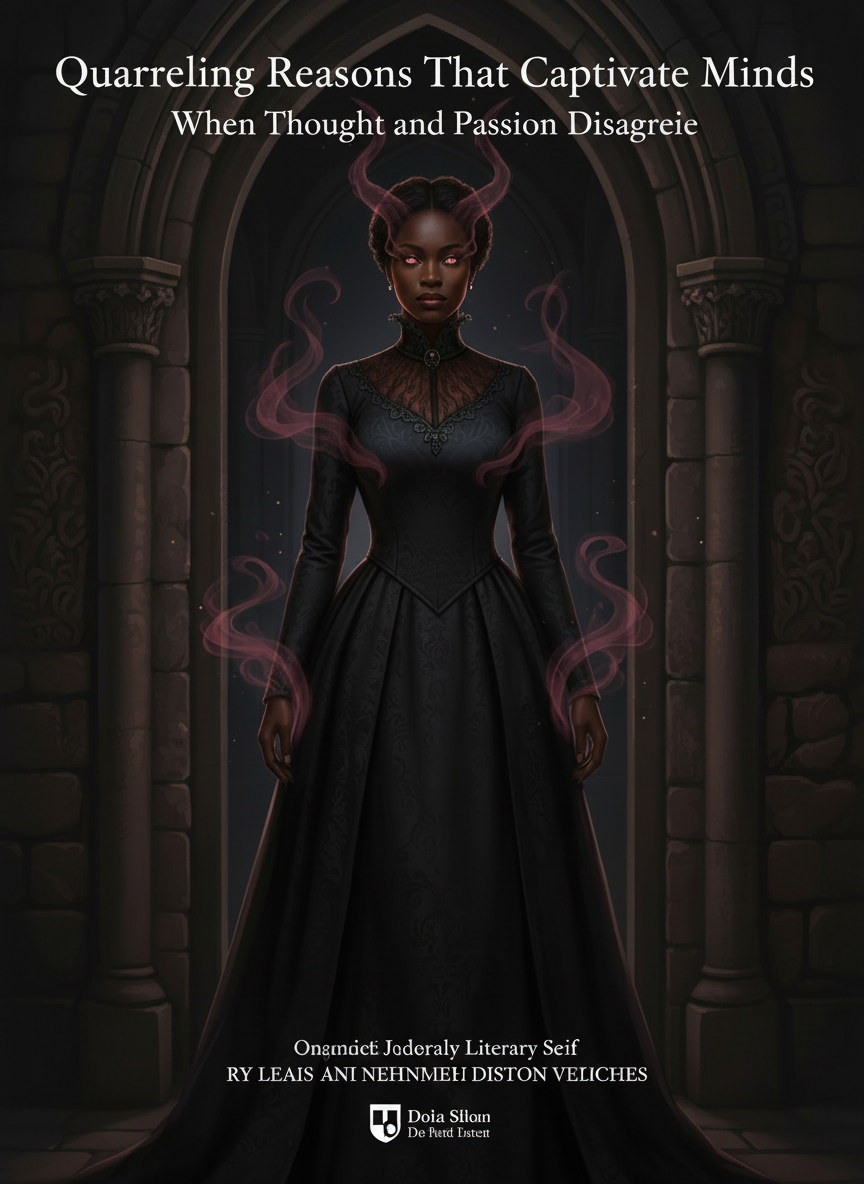
Her beautiful human appearance begins to break apart, not with violence, but with a terrible, quiet grace. Her pupils bleed outward until her eyes are an unnatural crimson, gleaming in the dark. Small, curved horns push through her hairline, glistening as if slick with some ancient memory. Her rich brown skin deepens and darkens, taking on a subtle pattern of scales that catch the light like onyx. Her legs twist into powerful, animal-like limbs that bend wrong and right at once, and a long, scaled tail uncoils from the base of her spine, dragging across the floor with a slow, deliberate scrape.
Lucian stares. His fingers clutch the couch until his knuckles go pale against his dark skin.
He should be terrified. Every story he was told as a child about devils and demons, about Black boys who strayed too far from the path and never came back, surges up like cold water in his chest.
Instead, he is fascinated. This, at least, is not a lie. This is not performance. This is something older and more honest than anything he has ever said in bed.
Evelyn tells him that she is a demon — and that humans have always misunderstood what demons want.
She doesn’t want his soul.
She wants something much more difficult to obtain.
His love.
Lucian laughs at first, a brittle sound that doesn’t reach his eyes.
He tells her that love is nothing but a lie people tell when they want something, that it’s just another story, another con, another contract signed in blood or sweat or loneliness.
Evelyn answers:
“Then you should be very easy to love.”
Before Lucian
She had loved a king once.
His name was Solomon, and he was the wisest man the world had ever known. He was Black and brilliant, a man whose words outlived his own bones. He wrote poems about her — long, aching verses about a love that consumed him. “Let him kiss me with the kisses of his mouth: for thy love is better than wine.” He meant her. Every word of it. He meant her.
But Solomon loved his wisdom more.
When she came to him in her true form — horns and crimson eyes and the ancient darkness she could not hide forever — he did not run. He was too wise to run. Instead, he studied her. He named her. He catalogued her. He wrote her down in careful words as though understanding her was the same as holding her.
It was not.
Evelyn left not because he stopped loving her. She left because he never stopped thinking. There was always a part of Solomon that stood outside the fire and observed — a part that belonged to God, to his kingdom, to his own legend. He gave her much. He never gave her everything.
She had been looking for everything ever since.
Seven hundred women. Three hundred more. She had watched Solomon try to fill the space she left with bodies and devotion. She was not proud of that. But she understood it. She had spent centuries doing the same — slipping into lives, taking what was offered, leaving before anyone could give her what she truly wanted and risk being unable to return it.
Then she found Lucian.
A liar. A manipulator. A man who had never told the truth about love a single day in his life. A man whose dark eyes never quite matched his promises, whose easy smile was always angled just a little toward the nearest exit.
And yet.
The Truth and the Choice
From the moment she reveals herself, something in their relationship shifts. The air between them is no longer crowded with small performances; it is dense with something heavier, truer.
Lucian discovers that Evelyn has been studying him from the beginning. Not by accident, not by curiosity, but with a patience that spans centuries. She knows every woman he has deceived: the girl he ghosted after college, the single mother he promised to protect and then left unanswered, the older woman who believed him when he said age meant nothing. Every promise he has broken. Every lie he has told. Every time he laughed at someone’s sincerity and called it foolish. She knows him better than he knows himself.
Yet the deeper Lucian falls for her, the more he begins to wonder whether Evelyn is actually manipulating him — or whether she has, impossibly, genuinely fallen in love with the man beneath all his lies. He sees it sometimes in the way her monstrous form softens when he touches her scaled cheek without flinching, in the way her voice trembles when he almost walks away and then turns back. He starts to suspect that he is not the only one risking something that cannot be named.
Then Lucian discovers the truth.
Evelyn has done this before.
There have been other men.
Other lovers.
Other humans who believed they were special.
And none of them survived loving her.
He does not learn this from her. He learns it one restless night when she is gone and he cannot stand the silence she leaves behind. He goes searching — first through her things, then through the corners of the internet where superstition clings like mold. He finds patterns in old stories: Black men and women who vanished after speaking of a strange, beautiful lover with eyes “like fire.” A scribbled note in the back of an inherited Bible: She comes as sweetness. Do not believe her. A yellowed newspaper clipping about a man found smiling in his sleep, heart stopped, no sign of struggle, lips parted as though whispering “I love you” to someone no one else could see.
Lucian realizes that the entire relationship may have been a trap from the beginning, a centuries-long pattern he has stumbled into like a moth into a lamp.
For the first time in his life, he wants to run.
But Evelyn gives him a choice. She appears in his doorway that night, not bothering with illusion, horns curling proud from her skull, tail coiled loosely around one ankle. Her eyes flick to the spread of papers and open browser tabs on his table, to the scattered proof of the men who came before him. She says nothing at first. Then, quietly, “You wanted the truth. Here it is.”
He stands in the middle of the room, feeling the weight of every lie he’s ever told pressing down on his chest. “Did you love them?” he asks, voice hoarse. “The others.”
She considers him for a long moment. “I loved what they could have become,” she says at last. “I loved the part of them that reached for something bigger than themselves. But they loved the idea of me more than they loved me. They wanted miracles without surrender.”
“And me?” he asks. “What do you want from me?”
“Everything,” she says simply. “No lies. No distance. No part of you standing outside the fire, watching yourself burn and calling it wisdom. I want you to step in.”
He realizes, with a sick twist of understanding, that this is the cruel joke he has been circling his whole life.
He spent his entire life lying about love because he believed love made people weak, made them foolish, made them easy to break.
Now he has become the weakest person in the room. Because the woman he tried to deceive is not human. She is a creature that has existed for centuries. And she has finally found the one thing she couldn’t take from anyone by force: a liar who is, for the first time, ready to willingly give her his heart.
The Ending
The night he chooses her, the city is quieter than usual, as if holding its breath. Lucian sits on the edge of his bed, elbows on his knees, hands threaded together so tightly his fingers ache. The door to his apartment stands open, the hallway beyond washed in the dull yellow of the building’s lights. He can leave. He can walk back into the life he had before — the easy lies, the casual entanglements, the safety of never meaning what he says.
Evelyn stands across from him, half in shadow. Tonight, she does not pretend to be anything but what she is. Horns, eyes, tail, the subtle shimmer of scales across her dark skin. She is both terrifying and beautiful, the embodiment of every warning he has ever ignored.
“If you walk away,” she says, “I will not follow. I will not haunt you. You will go back to your games, your half-truths, your empty beds. You will live. You might even be happy, in the way you understand happiness.” She takes a step closer. “If you stay, you will not be the same man tomorrow. Or ever again.”
Lucian thinks of Solomon, the king who loved wisdom more than fire. He thinks of the women he hurt, of the look in their eyes when they realized he had never meant the words that had undone them. He thinks of the strange, impossible tenderness he feels when Evelyn laughs at something small and human — the way his chest aches, sharp and bright, because he knows that for all her power, she, too, can be hurt.
He understands, finally, that there is no version of love that does not demand something from him. No safe distance from which he can watch his own heart and take notes.
He stands. His legs are unsteady, but he crosses the space between them anyway. The air around her is warmer, humming with a quiet, ancient energy. When he reaches her, she does not move to meet him. She waits.
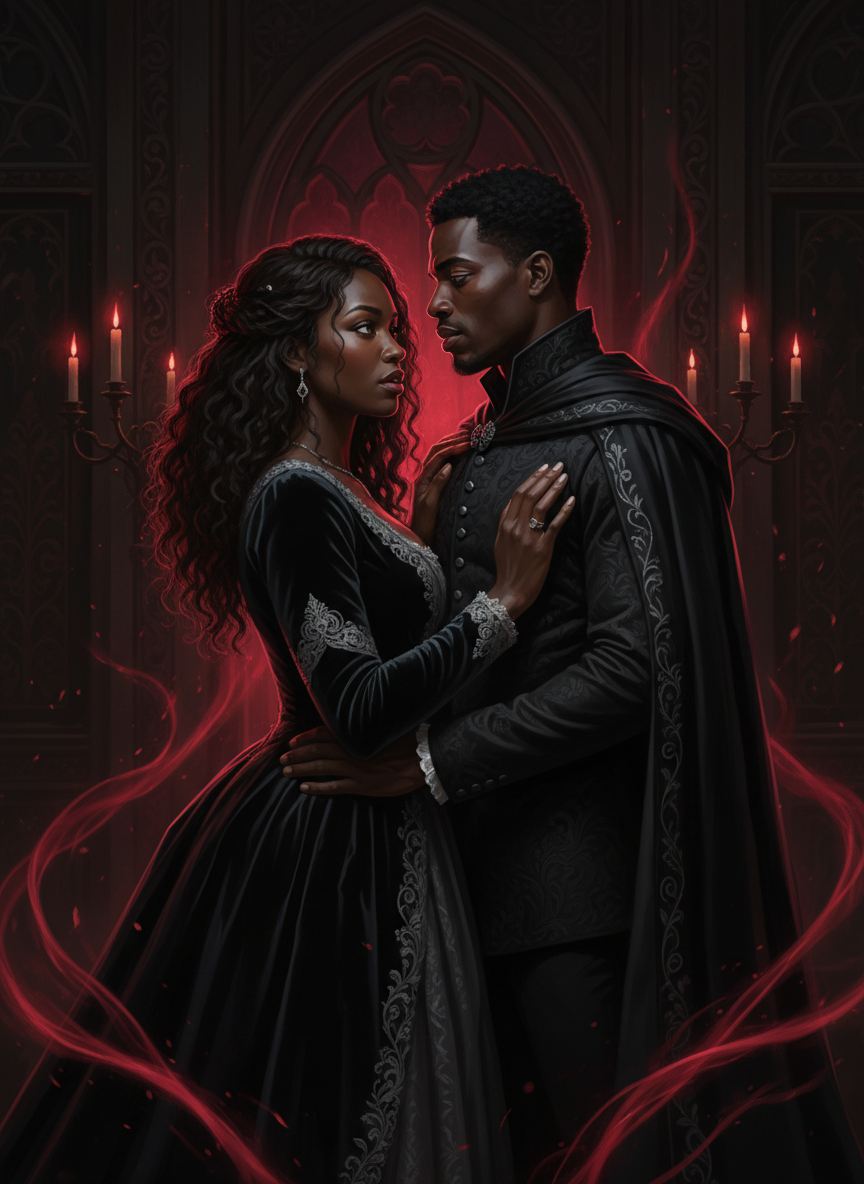
As he embraces her, her body is both familiar and strange beneath his hands — soft where it was soft before, scaled where it was not, heat pulsing beneath skin that is no longer just human. She leans into him with a weight that feels like trust and doom all at once. Her lips brush his ear as she whispers:
“Tell me you love me.”
Lucian pulls back just enough to look into her red eyes. They are not kind, not safe, but they are honest. They are the truest thing he has ever seen.
For the first time in his life, he tells the truth. “I love you.” The words leave him like a confession, like a curse, like a prayer. He feels something inside him loosen and something else clamp down in its place.
Evelyn smiles, slow and devastating. She lifts a clawed hand and cups his face with unbearable gentleness. Behind him, the open door shivers once, then begins to fade, its frame blurring as though swallowed by darkness. The hallway light dims to nothing. When he glances back over his shoulder, there is only smooth wall where escape used to be.


Leave a comment