Letters from Xhale — Words that breathe. Stories that linger. Original short story.
Three Days
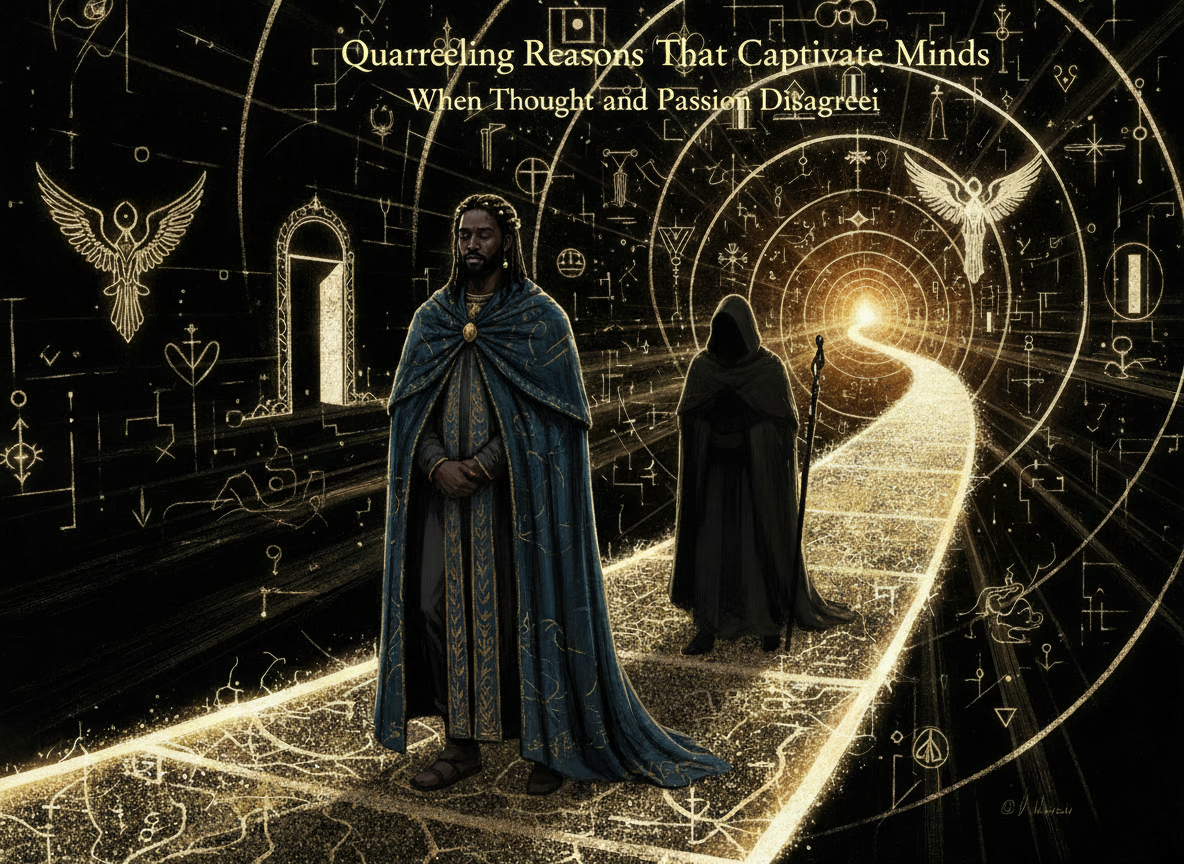

When the darkness closed, there was no jolt, no falling. Only a soft unhooking, as if the world itself had been holding its breath and finally let go. The sound of the crowd dimmed, the taste of iron and vinegar thinned on his tongue, and the weight slipped from his torn shoulders. For a moment there was nothing—no sky, no earth, no wood, no pain. Only a long, held silence like the rest between notes.
Then he noticed his feet.
The holes were the first thing he saw. Not as wounds but as clearings, small clean circles of absence in the flesh. There was no blood anymore, no throb, no heat radiating up his calves. He lifted one foot, then the other, in a quiet astonishment. They moved without protest, bearing his weight as if nothing had ever pierced them.
He wiggled his toes. They responded. He pressed his heel to the unseen ground beneath him. Solid. Sure.
There was no pain, only memory.
He looked up.
A corridor stretched ahead of him, narrow at first, then widening, then narrowing again as if it breathed. There were no walls, and yet there was a sense of sides, of boundaries. Pale light ran along its length, not from lamps or torches but from the space itself, a soft radiance with no visible source. Behind him, there was only the feeling of something sealed: the cross, the cries, the final breath emptied like a cup turned over. Before him, the corridor arced away into a distance that was not measured by steps or time.
He took one step forward, then another. The movement felt natural, as though he had been born to walk this in-between place, this narrow way between death and whatever waited beyond it.
Somewhere in the distance, a voice slipped through the space like smoke through keyholes.
“So,” it said conversationally, as if they had met on an ordinary road on an ordinary day. “They finally killed you.”
He did not startle. Fear belonged to the other side, with the nails and the accusations and the turning of faces away. Here, the words reached him cleanly, like an echo arriving without the original sound.
“I gave up my spirit,” he replied. His own voice surprised him. It carried the roughness of dust and teaching, the intimacy of whispered parables, and the hollow of having been emptied. It did not shake. “They did not take it.”
The corridor thickened beside him, like mist coalescing. A shape formed where there had been only suggestion. Not a horned terror, not a caricature of malice, but a presence in a dark cloak that seemed woven of all the shadows that had ever fallen on human faces. The features shifted when he tried to fix them: a familiar profile from a remembered crowd, a beloved outline from a childhood morning, the stern look of a teacher, the proud gaze of a ruler. Every shape was recognizable, and every shape was wrong.
“Of course,” the figure said. “Semantics. But you are here now, and they are there, with their grief and their holy confusion.”
“They are not alone,” he said quietly.
The figure smiled. It did not reach the eyes, whatever eyes it wore.
“You really believe that.”
He looked down the corridor again. It was longer now, or perhaps it always had been. The sense of movement was strange: he was walking, but there was also the feeling that he was being drawn, like a tide pulled toward a moon. It was not compulsion; it was fulfillment, the natural end of an arc long set in motion.
The presence fell into step beside him.
“Tell me,” the voice said mildly, “how does it feel? The wood, the thorns, the nails, the spittle. The weight of everything they are and everything they refuse to be, pressed into your lungs until you could not breathe. Does it ache in there still?”
He thought of the cross, the slow unfolding of suffocation, the uneven rhythm of lifting himself against the spike in his feet just to drag in one more breath for one more word. He thought of the jeers, the tears, the strange compassion of the soldier with the spear. He listened inwardly, exploring his own absence of pain.
“No ache,” he said. “No sting.”
“Nothing?” The voice feigned disappointment. “Not even a little satisfaction? You did love your words of judgment as much as your words of mercy. Woe to you, hypocrites. Whitewashed tombs. You had some fire.”
His lips curved, almost rueful.
“I felt humanity,” he said. “All of it. On the cross, it was not their insults that burned. It was the distance they believed was there. The space between their reaching and the One who had already reached for them.”
The shadow glanced sideways at him.
“You speak as if you weren’t the one nailed there. As if it was all theory. An object lesson.”
He stopped walking. The corridor accommodated, its light folding gently around their halt.
“It was not an object lesson,” he said. “It was the most real thing I have ever known.”
He touched his side where the spear had entered. There was no wound now, but his fingers remembered the invasion, the cold clarity of steel parting flesh already slack with death.
“And yet,” the presence pressed, “here you stand. Intact. Undefeated. Ready to go on to whatever triumph they have promised you. Crowns, songs, gates of pearl. You are very hard to kill.”
He resumed walking. The corridor responded with a subtle hum, like a chord struck and allowed to resonate.
“The cross was not the end,” he said. “It was the door.”
The figure laughed softly.
“Doors swing both ways.”
They walked in silence for a while. Time, if it existed here, unfurled without hours. Moments were measured instead by shifts in the air, by the way the light paled or deepened as if remembering different days.
When the change came, it came sideways. He smelled dust first—hot, flayed by sun, familiar in his nostrils. Then hunger, that sharp interior hollowness that made the world sound louder. The corridor around them blurred, and for a breath he was no longer between death and what lay beyond; he was again in the wilderness, stone and scrub and a sky too wide to bear.
Forty days of emptiness pressed against him like a remembered fever. His ribs stood out beneath his skin. His lips were cracked. The wind scraped his throat. He knew this place. He knew this trial.
The tempter stood before him yet again, more defined now, wearing a face that would have passed unnoticed in any crowd. Dark eyes, a mouth accustomed to both laughter and lies. Hands open, persuasive.
“If you are the Son of God,” the voice said, the old words emerging like a well-rehearsed line, “tell this stone to become bread.”
But now the hunger was only memory too. He felt its ghost, but it did not master him. He watched this replay of a battle already won.
“You remember this,” the figure beside him in the corridor murmured, as if commenting on a scene in a play. The wilderness and the corridor seemed to overlay one another, two transparencies imperfectly aligned. “I tried questions then as well. ‘If you are.’ Such a small hook. It catches so many.”
“Identity,” he said. “Always your favourite wound to probe.”
“It works,” the devil replied with a shrug. “What they are, what they are worth, what they must do to prove either. I ask and they bleed. But you didn’t.”
“I was full then, even when empty,” he said. “Full of a voice that had already named me.”
The memory shifted. In an instant, wilderness stone became mountain rock, sharp and cold beneath his bare feet. The view sheared away below them in all directions, a world stretched out like fabric on a loom. Cities burned with evening light. Roads braided over hills. Rivers shone like wounds. People moved like ants, like stars fallen to earth.
He remembered the offer before the words were spoken.
“All this authority I will give you,” the adversary said, spreading his arms wide, as if he owned the horizon. “And their glory. It has been delivered to me, and I give it to whomever I will. If you, then, will worship me, it will all be yours.”
The world below beat like a pulse. Kingdoms upon kingdoms. Thrones paired with chains. Altars slick with offerings given in hope and taken in fear.
A Note from Xhale
Three Days invites contemplation of the in-between: that corridor where flesh meets spirit, where doubt walks alongside faith, where the most profound questions linger without resolution. As a film, it would exist in the space between realism and the numinous—a meditation on Yeshua’s passage toward resurrection, rendered not as triumph but as mystery. The Devil here is not villain but interlocutor, a voice that speaks the doubts we carry, the weight we cannot quite set down. The story asks: what does grace mean when it reaches for the guilty? What does love look like when it chooses the difficult path? These are the questions that breathe at the heart of redemption, the ones that linger long after the stone is rolled away.
“You have always been fond of shortcuts,” the figure in the corridor said lightly, as the memory-mountain wind tugged at his cloak. “And here you are now, after choosing the long road. After choosing the nails.”
He looked at the kingdoms as they had been and as they were now, layered realities visible at once. He saw the momentary glitter and the long erosion. The shouts of victory and the quiet whimpers in back rooms. Palaces and prisons separated by only a wall, sometimes not even that.
“You mistook my refusal,” he said softly. “You thought I did not want them.”
The shadow’s brows rose.
“I wanted them too much,” he continued. “But not as trophies. Not as proof of my power.”
He let the mountain bleed away, the wilderness recede, until only the corridor remained, quiet and steady.
“If redemption stops at innocence,” he said, his eyes on the path ahead, “then grace is a lie.”
The words hung in the air between them, luminous.
The devil’s expression shifted—curiosity, irritation, something almost like respect flickering and vanishing.
“Explain,” he said, his tone no longer quite lazy. “You had your innocents—little ones on your knees, women pouring out their shame with their tears, men who had not yet learned how to betray themselves. You forgave easily then. No great cost. A kind parent’s indulgence.”
“And the thief?” he asked quietly.
The scene rose up around them before the other could answer.
Wood again. Sky again. The press of bodies. The metallic scent of blood that had once made his own stomach churn now came only as a remembered vertigo. On either side of him, two men hung on their own instruments of slow extinction. He could hear them breathing as if it were happening still: the ragged pulls, the bitten-off groans. The mocking of one, sharp with the panic of a man watching his own life narrow to a splinter of pain. The other’s defense, surprising in its clarity.
“We are receiving the due reward of our deeds,” that one had said, words snatched from him between the nails. “But this man has done nothing wrong.”
He remembered turning his head, every muscle protesting, to look at the face only a few arm’s lengths away. A face like any other. A face with too many years of wrong choices written into the lines around the mouth, into the flinch around the eyes. A face smeared with sweat and fear and a strange, stubborn hope.
“Yeshua,” the thief had said. Not “Lord.” Not “Master.” Just the name they had called him in his mother’s house, in the narrow streets of his youth. The name spoken when he skinned his knees or fell asleep by the fire. “Remember me when you come into your kingdom.”
The corridor flickered. For a moment, it carried the smell of Golgotha, the rustle of gambler’s dice, the sharp cry of one of the women who loved him.
“Today,” he had answered then, pain-torn but clear, “you will be with me in paradise.”
He spoke the words again now, in the between-time, tasting their inevitability. The thief’s crimes had not been unmade. The lives he had broken were not rewoven in an instant. Innocence did not return to him. Something else did.
“He carried his guilt with him to the very edge,” he said softly. “And I met him there. That was always the point.”
The devil watched him, face unreadable.
“You forgive thieves, adulterers, persecutors, cowards,” he mused. “You take their rot and call it fertile soil. But what of the others? The ones whose injustice builds systems, whose cruelty is an institution, whose fear is a law? How far does this door of yours open?”
He did not answer immediately. Somewhere just out of sight, a song began, low and without words, like the tremor before an earthquake or the breath before speech. The corridor brightened not with new light but with a recognition of light that had been there all along.
“You keep asking the wrong question,” he said at last.
“I ask the only question that matters.”
“No,” he replied. “You ask, ‘Who deserves it?’ I am answering, ‘Who needs it?’”
The devil gave a short laugh, brittle and bright.
“They all need it. Every last one. You made sure of that when you set the bar at perfection.”
He turned his gaze fully on the one walking beside him. For the first time, the shifting faces stilled. What he saw now was not a stranger but a familiarity so ancient it hurt: the memory of a morning star, the echo of a song begun in one key and finished in another.
“You remember,” he said gently.
The devil’s jaw tightened.
“Remember what?”
“The first name you ever heard over you.”
Silence fell, heavier than any nail.
They walked. The corridor shifted again, not into a place he had been, but into something older than places. There was no sky, no earth. Only the pure resonance of being called good, of light declared into existence and answering with its own radiant yes.
“Do not,” the devil said quietly, and the word trembled with something that might have been fear, might have been longing. “Do not speak to me as if we were still there.”
“We are not still there,” he agreed. “But eternity does not lose what it has held. Even your revolt could not erase the moment you knew yourself beloved.”
The devil’s hands closed into fists.
“You speak of belovedness on the far side of a cross surrounded by mockery and failure. Your followers scattered. Your movement snuffed out by a well-placed Roman execution. Listen.”
The corridor thinned. For an instant, he could hear them: Peter’s muffled weeping, the shuffling of feet in a locked upper room, the rasp of rope sliding over stone as his body was lowered from the wood. The sob of his mother, too tired now for words.
“This,” the tempter said, “is what you left them with. An empty Saturday. An unanswered cry. ‘My God, my God, why have you forsaken me.’ Your godforsaken last word.”
The words echoed down the corridor, not as accusation, but as something more tender and terrible.
“‘My God, my God, why have you forsaken me’ — was that a question?” the devil asked, his voice low. “Or was it the first crack in your certainty? At the edge, did you finally taste what they all taste: doubt, and the sick twist of realizing you might have been wrong?”
He closed his eyes. On the cross, that cry had torn from him like something ripped from bone. The sense of abandonment had been absolute, a cavern open beneath his feet into which every assurance seemed to fall. It had been exile squeezed into a single breath.
But inside the desolation, there had been another sound, softer, like a melody braided through grief. Old words, learned at his mother’s knee. Words of a song that began with absence and ended with trust.
He opened his eyes again.
“No,” he said. “It was not a question.”
He looked ahead into the brightening distance of the corridor, then back at the one who had walked beside him from the first step.
“It was a prayer,” he said. “For everyone who ever has felt abandoned.”
The air around them stilled as if listening.
“A prayer,” the devil repeated, tasting the word. “To whom? To a Father who turned his face away? To a presence that retreated so fully you felt forsaken even as you spoke? Perhaps that is the only honest prayer: one whispered into a perceived emptiness.”
“Honesty is not measured by what we feel,” he said softly. “But by to whom we speak when we feel it.”
They had come, he realized, to a bend in the corridor. He had not seen it until now, but there it was: a subtle curvature in the light, a turning that suggested a destination not much farther. The air at that bend pulsed with a different quality of brightness, as if dawn lived just around the unseen angle.
The presence beside him faltered, almost imperceptibly.
“So this is it,” the devil said. “The hinge. The moment when whatever you are planning comes into full view. Empty grave, astonished friends, the slow march of interpretations and institutions that will swallow your name whole. They will do such things with your story.”
“They will misunderstand me,” he agreed. “They will use me as a weapon and as an excuse. They will forget my tears and remember only my commands. They will build towers and call them my house. They will speak my name to bless their wars.”
“And yet you go on.”
He nodded.
“Why?” The question came abrupt, sharper than the others. “Why, when you know what they will do with your gift? They will make it about earning, about proving, about belonging and being excluded. They will make the door you carved with your own torn body into a gate they can control.”
He regarded him for a long, quiet moment.
“Because some,” he said, “will walk through anyway. Despite the noise, despite the fences, despite the misused words. A careful plot helps with life. Their stories will find themselves in mine. They will taste grace like clean water in the midst of all the poison. One life, then another, then another. They will not make headlines, but they will make heaven ring.”
The devil’s mouth twisted.
“Small returns for such an investment.”
“Each is all,” he answered simply.
The presence looked toward the bend in the corridor as if it could see through it to the garden, the stone, the folded linen. For the first time, he seemed unsure whether to follow.
“You haven’t asked me once,” the devil said quietly, “if I regret it.”
He thought of that first bright rebellion, of glory turned in on itself. He thought of an intellect turned razor against its own source, of a beauty setting itself on fire rather than reflecting any light it did not own.
“You are not a question to be solved,” he said. “You are a mystery to be grieved.”
The devil flinched as if struck.
“Spare me your pity.”
“It is not pity,” he said. “It is love, thwarted. It knows what it could have been. It remembers what we sang together.”
For the first time, the corridor seemed too narrow for the presence at his side. The shadows pulled tighter around him, as if protective, as if ashamed.
“Don’t,” the devil said again, but now there was no force in it. “Don’t call me back to a name that no longer fits.”
He stood still. The bend in the corridor pulsed gently ahead, patient.
“I am not calling you back,” he said. “I am bearing witness that you were once more than what you have become. That every creature who walks in darkness was born in light. That is part of the good news they will stumble over and keep rediscovering.”
The devil laughed harshly.
“Good news. Tell them that their accuser was once a singer. Tell them that their fear began as worship. See how it comforts them.”
“Not comfort,” he said. “Perspective. If even you began in goodness, then what they have twisted can be untwisted. Not by their own cleverness. By mine.”
He took a step toward the bend.
“And you?” the devil called after him. “What do I call you now? King? Lord? An empty tomb with a story attached?”
The question followed him, skittering along the corridor like loose pebbles. He paused and turned.
For a moment, they stood facing each other at the edge of the turn, the unfallen light ahead of him, the tangled shadows behind.
The devil searched his face, as if hoping to find there some crack, some uncertainty, some leftover doubt from the cross that he could worry open.
“What do I call you?” he repeated.
The answer rose in him like something older than breath.
“You know my name,” he said.
For a heartbeat, the corridor stilled. Then the devil spoke it, the syllables edged with reluctant intimacy.
“Yeshua,” he said. The name before everything, before crowds and crosses and kingdoms. The name that had existed when he was only a child in a village, when he was only a promise, when he was only a word hovering over waters much older than Galilee. The name that had been whispered in eternity before anything was made.
It sounded different in that mouth, but it was the same name. It vibrated in the space between them with all that it had ever meant: the Holy One saves.
He felt, then, not triumph, but a vast sorrow transformed. The cross, the thieves, the wilderness, the kingdoms—all gathered themselves into a single line through his being, a story whose ending was not a tomb but something deeper and higher than any grave could hold.
He turned toward the bend.
The devil watched him go, questions accumulating like storm clouds. One more, he thought. Just one more question the right size, the right shape, the right poison. Something to hang in the air and follow him beyond this corridor. Something to plant doubt in the hearts of those who would hear about him later.
But the words would not come.
The devil had no question ready.
And Yeshua kept walking. Toward the third day.


Leave a comment